I had an experience that shook me to my core regarding AI and social sustainability and I wish to share this experience with you.
I was setting up a trial website for a start-up idea I have for a non-profit network organization working to increase awareness and develop methods for improving social sustain-abilities. I bought the domain name socialsustainabilities.org along with an email account, basic webhotel and wordpress website creator to get started on this idea. (Would you believe that social sustainability and social sustainabilities domain names are even still available??) I wanted to register for an event related to social sustainability, but I needed to sign up with a work email, not a personal email, so I started the process of setting up an email account. There was a “1-click installer with WordPress” tag which I was curious about, so I clicked this and was sent to WordPress. I was asked if I wanted help setting up my website, and if I wanted help from AI – I was curious how AI could help.
I was asked to put in some text regarding what I wanted my website to be about. I put in a hastily written text about putting people and social contexts in focus, fostering well-being in a variety of social contexts including workplaces, schools, and local communities. I said it was a non-profit organization, and I wanted to instigate change. I plugged in this basic text, and clicked next.
What happened next was utterly shocking.
Fake social sustainability
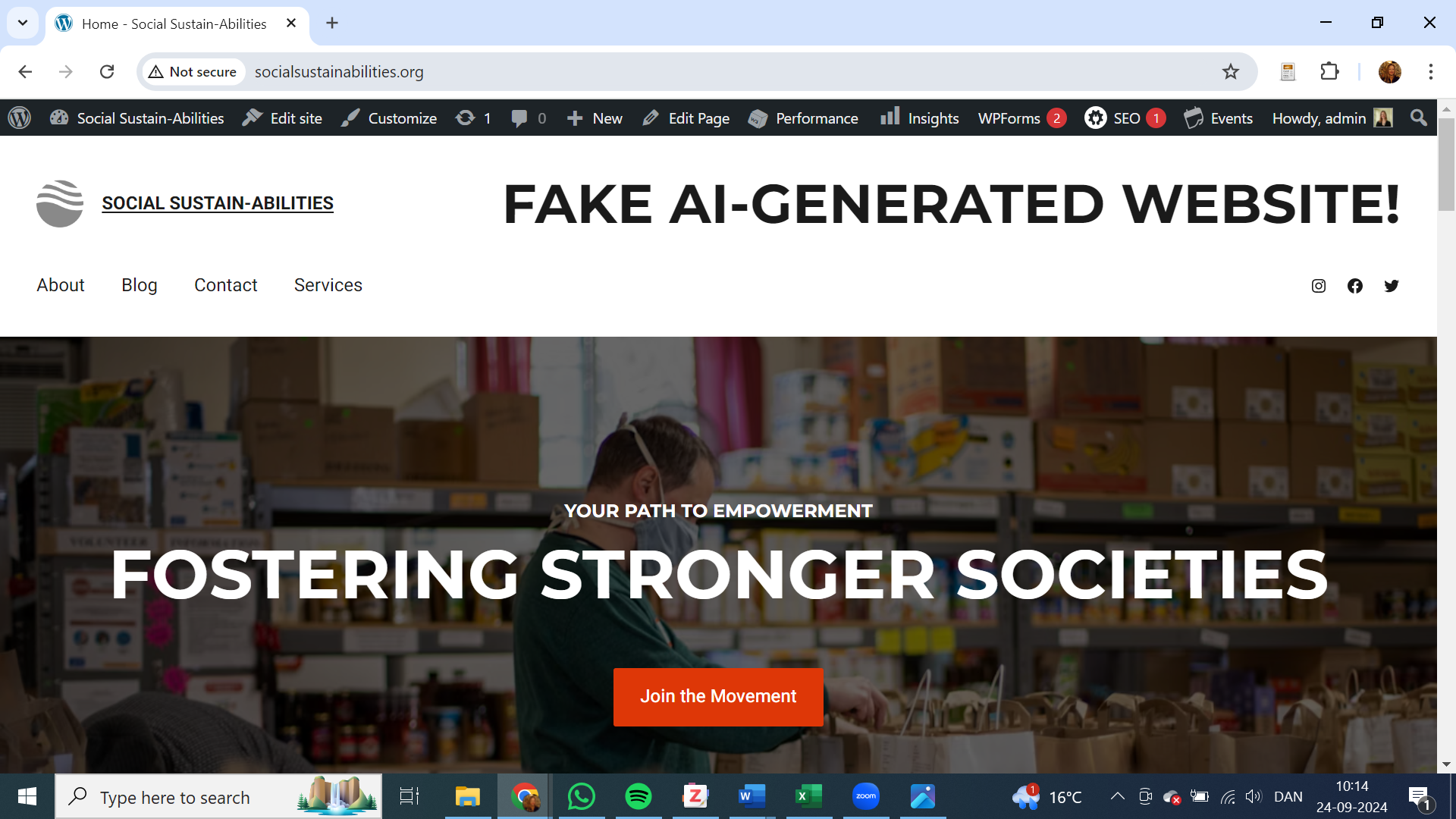
All of a sudden, I had a socialsustainabilites.org website. With multiple pages. And lots of photos and content. There were also people. Fake people. Fake staff working in my now Fake NGO. Fake testimonials from Fake people. Fake events. And even a fairly prominent Fake Donate page.
It was incredibly striking how AI imagined a project on social sustainabilites. It reflects how social sustainabilities is primarily conceptualized/framed – as work to support disenfranchised communities. The site was full of highly problematic photos of young Black children, such as on one page next to a “Empower your creativity workshop” which is taking place on August 26, 2026. There’s a local garden volunteer day with someone passing out food. And a photo of hands together for a social health symposium on October 14, 2026.
I have to admit, the text in the website is catchy, if not generic and problematic. There are great initiatives the AI-generator thought of related to health, education and community. Yet it’s fake. All of it.
Real Social Sustainability
Social sustainability is imagined, according to my fake website, as something for “underserved communities”- communities that don’t have access to food, health services, education and creativity.
Yet that is not how I imagine social sustainability. I imagine social sustainability as something EVERYONE needs, all communities. I have actually not considered focusing on underserved communities in my work with social sustainability. There are a multitude of philanthropic organizations, NGOs, foundations, etc. who do this work, and do it well. Even though there is much more work that needs to be done.
The rhetoric of struggle and need of help is in relation to poor, undereducated, minority communities. And social sustainability entails wealthy, overeducated, majority communities helping these underserved communities. This positions those who are weak and those who are strong in societies, inadvertently furthering a white savior complex. And what about the wealthy, overeducated, majority communities? Do they not struggle or need help as well? Of course they do, but this is something that typically they must face individually- something private, unshared, and possibly shameful.
I am not advocating for not providing aid for underserved communities. What I am advocating for is the recognition that the social fabric, our social sustainability, is something we need to pay attention to and re-think how we can develop our capacities, our abilities, so that we can thrive as a society, as a group. Not merely as individuals. Not only considering the well-being of ourselves and those closest to us, but expanding our circles of connection to consider our collective well-being.
Maintaining the real in the realm of the fake
How do we know if something is real now? We can no longer tell by looking it up online. We can’t trust anything online anymore. Of course I knew this. But I haven’t experienced this so intimately before, which is why I felt shaken to my core when I became the owner of an AI-produced Fake website. I assumed the AI help would be related to content, not people. Fake staff, testimonials, events involving people was what shook me, and the ease with how this was created. One-click.
With the expansion of AI into every aspect of our lives, real, authentic, genuine, face-to-face connections are more important than ever. While our online lives increasingly occupy our space and imagination, we need to make sure that our connections to real people and the social environment we live in do not diminish but become strengthened even further. That is the only way we will be able to distinguish between fake and real, and maintain our humanity in an increasingly inhumane world.

 Elizabeth Williams Ørberg